How Would a Psychologist Describe the Small Intestine
This hole allows intestinal contents to spill into the abdominal cavity. The small intestine is an organ located in the gastrointestinal tract between the stomach and the large intestine.
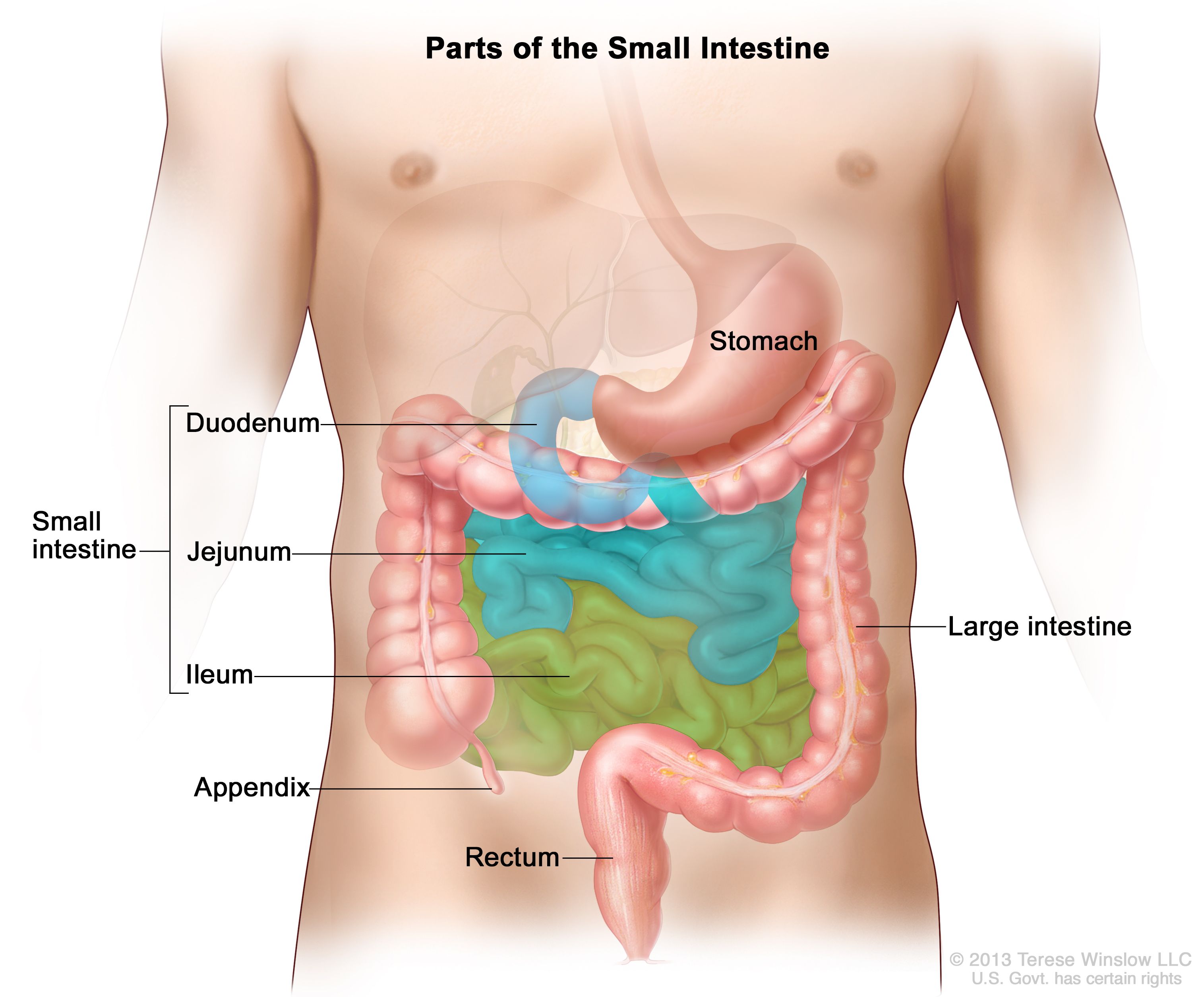
Definition Of Small Intestine Nci Dictionary Of Cancer Terms National Cancer Institute
Page 7 Compare and contrast the mechanisms for intestinal.
. The small intestine has a large surface area for more efficient digestion and absorption. Although the small intestine is the workhorse of the system where the majority of digestion occurs and where most of the released nutrients are absorbed into the blood or lymph each of the digestive system organs makes a vital. The blood leaving the small intestine includes the secretions from the duodenal culs What best describes the blood that leaves the small intestine.
The small intestine is however about twice the length of the large intestine and usually. It is rich with lipids and other nutrients the stomach has absorbed through the mucosa It has an acidic tide - low pH It has an alkalinic tide - high pH It has a neutral tide. It receives the secretion of liver and pancreas for this purpose.
The small intestine breaks down food from the stomach and absorbs much of the nutrients from the food. PH around 70 -. It is on average 23ft long and is comprised of three structural parts.
In the small intestine food is broken down into liquid and most of its nutrients are absorbed. The small intestine is longer than the large intestine. It is a highly coiled structure of about 75 meters in length.
The three main regions of the small intestine are the duodenum the jejunum and the ileum. It is narrower than the large intestine. Your small intestine is the longest part of your digestive system - about twenty feet long.
Colon cecum rectum and anal canal are the components of the large intestine. The small intestine consists of the duodenum jejunum and ileum. What are four characteristics of the small intestine.
The three main regions of the small intestine are the duodenum the jejunum and the ileum. It is wider than the small intestine. The small intestine is where digestion is completed and virtually all absorption occurs.
It is given the name small intestine because it is only 1 inch in diameter making it less than half the diameter of the large intestine. The small intestine is where most digestion takes place. The small intestine is actually the longest segment of the gastrointestinal tract the long continuous pathway that food travels through your digestive system.
Locating the Small Intestine. The small intestine is the longest part of the alimentary canal. The small intestine is several feet long.
The three components of the small intestine are duodenum jejunum and ileum. Because it is so long it must twist and turn through the abdomen. Page 7 What enzymes are used to complete the digestion of carbohydrates in the duodenum.
The ileum meets the large intestine at the ileocecal valve which joins the large and small intestine. Describe The Small Intestine Question 9 1 pts If a 70 kg female has a total body water of 36 L and their intracellular Muid volume is 24 L. Page 7 Describe the transcellular transport mechanism of water absorption in the small intestine.
The small intestine is made up of three segments which form a passage from your stomach the opening between your stomach and small intestine is called the pylorus to your large intestine. How would a physiologist describe the small intestine. Functionally the small intestine is chiefly involved in the digestion and absorption of nutrients.
These juices make the internal condition of the intestine gradually to a basic or alkaline one. It is the site of the complete digestion of carbohydrates proteins and fats. The function of the digestive system is to break down the foods you eat release their nutrients and absorb those nutrients into the body.
It is shorter than the small intestine. What is her estimated interstitial fluid volume. Most vitamins and minerals as well as fats and some water are absorbed in the small intestine.
Page 7 Describe the function of brush border enzymes in the duodenum. It has three areas called the duodenum the ileum and the jejunum. Your small intestine does most of the digesting of the foods you eat.
Ironically the longest part of the alimentary canal is the small intestine. The duodenum jejunum and ileum. The small intestine wall contains circular and longitudinal layers of smooth muscle.
It connects your stomach to your large intestine or colon and folds many times to fit inside your abdomen. Intestinal contents from the lower small intestine and. O 1924 288L 0961 0 241 144L Question 10 1 pts The internal environment includes which of the following choose all that apply.
The duodenum the jejunum and the ileum which contribute 5 percent nearly 40 percent and almost 60 percent of the small intestine respectively. The small intestine wall contains circular and longitudinal layers of smooth muscle. 1 tube measuring 1 inch in diameter 2 about 20 feet long 3 consists of coiled loops 4 fills most of abdominal cavity What are the.
These villi and microvilli increase the surface area of the duodenal lining allowing for greater absorption of. The hole can be a cut tear puncture or rupture. The Small Intestine.
The small intestine is a 20-foot-long tube that is part of the digestive tract and connects the stomach and the large intestine. The waste is passed on to the large intestine. The three main regions of the small intestine are the duodenum.
These two activities are facilitated by structural adaptations that increase the mucosal surface area by 600-fold including circular folds villi and microvilli. It is the site of complete digestion in. The first few inches of the duodenal lining are smooth but the rest of the lining has folds small projections villi and even smaller projections microvilli.
The small intestine or small bowel is a hollow tube about 20 feet long that runs from the stomach to the beginning of the large intestine. This short section is the part of the small intestine that takes in semi-digested food from your stomach through the pylorus and continues the. The small intestine has three subdivisions.
It is a very narrow tube with a large internal surface area. The small intestine is where digestion is completed and virtually all absorption occurs. A bowel perforation is a hole in either the small intestine or large intestine.
The small intestine has a large surface area for more efficient digestion and absorption. What are the functions of the 3 parts of the small intestine. These two activities are facilitated by structural adaptations that increase the mucosal surface area by 600-fold including circular folds villi and microvilli.
The small intestine is a long highly convoluted tube in the digestive system that absorbs about 90 of the nutrients from the food we eat.

Small Intestine Anatomy Of The Small Intestine Human Digestive System Intestines Anatomy Human Anatomy And Physiology

Small Intestine Function Location Parts Diseases Facts Large Intestine Human Digestive System Large Bowel

Three Of The Small Intestine Sections Intestines Digestive System Anatomy Intestines Anatomy

Comments
Post a Comment